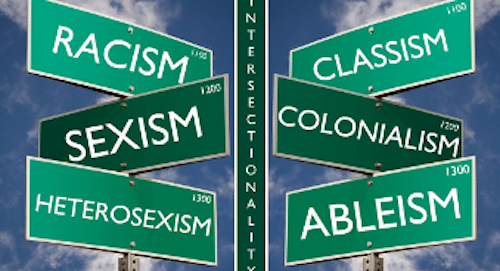
Intersectionality, what the heck does that mean? I had never come across it before in my everyday life, but as I embark on the Provocations paper it is one of hot topic. So what is this “Intersectionality.” A term conjured up by American law enthusiast Kimberlé Crenshaw in 1989, one would call her an expert in race and feministic law. In 1976 Kimberlé was investigating a case where black women could not receive secretarial roles at General Motors, where the white female employees were freely given these types of roles. Black men on the other hand were automatically given factory roles. An issue that debarked the issue of both race and gender. Atrocious both injustices at the same time, it had never been heard of previously. This formed the word “Intersectionality” as US law did not account for both issues together only as separate entities, it was either racist or sexist not both. Intersectionality relates closely to its sister term feminism but also identifies the wider umbrella which includes a variety of social, political prejudices which intertwine with the female gender. But contrary these terms may be strongly linked and related feminist don’t quite like the term ‘intersectionality’ as feminist don’t agree how some women can be advantaged than other women. Feminist believe that as women they have the same commonalities and struggles as women (D’Cruz, 2019).
Crenshaw’s term when originally derived focused heavily on race and gender. In modern day this has been exaggerated to include different aspects such as disability, sexuality and the list is never ending, goes on and on. Scholars argue that yes it has a place in modern day theory but the specifics have not been implemented and has much room to be misinterpreted and weaved into different ideas as the fundamental grounding is limited. Also limiting this idea of intersectionality as being derived and specific to the US in times where black people were being oppressed (Hancock, 2016).
Adolfo Aranjuez writes this becomes an ‘Oppression Olympics.’
He states the following “as a young, brown, queer, effeminate migrant with mental illness … I’m a minority on six levels, trumping a middle-aged, straight white man” (D’Cruz, 2019).
Aranjuez states we are doing ourselves an injustice by putting names on everything, what was intended to explain race and gender has now been a label for every injustice. What we need to be doing is uniting with each other rather than segregating our differences. We should rally up together to identify our differences. Like in schools are differences are to be celebrated not ostracised and segregated to the point students feel isolated. Let’s lift each other up for our differences. It is important to identify that we are all different but at the end of the day we are all human, so if we respect each other for our differences that should outshine any prejudices and hate. We all have a common goal and that is to be happy and live our own lives however we choose to live it.
D’Cruz, C. (2019, February 28). Explainer: What does ‘intersectionality’ mean? Retrieved August 8, 2019, from http://theconversation.com/explainer-what-does-intersectionality-mean-104937
Hancock, A.-M. (2016). Intersectionality : An Intellectual History. New York, NY, United States of America: Oxford University Press. Retrieved from http://search.ebscohost.com.ezproxy.aut.ac.nz/login.aspx?direct=true&db=edsebk&AN=1084660&site=eds-live
 Diary of the beginner teacher...